
For tournament organizers
Run better padel events.
Create, publish and run tournaments in one workflow — formats, participants, waiting lists, courts, live scoring and final standings. No Lunda Padel subscription, no platform commission.
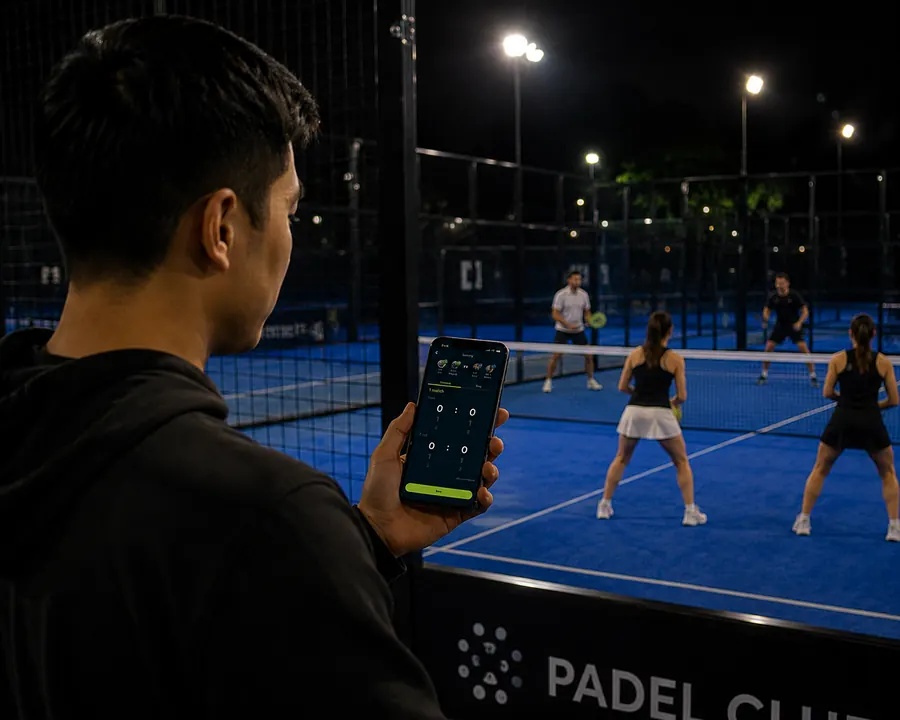
Real organizer interface mid-event: current round, court assignments, scores being entered, waiting list on the side. The screen a person actually looks at while standing next to the court — not a marketing dashboard.
MOTION — record the real screen for twenty seconds during an actual event, then slow it to 0.75×. Scores land, the next round generates, the court list reshuffles. Nothing staged.
Faster setup
Duplicate last month's event instead of rebuilding it.
Participant control
Rules decide who gets in, so you are not moderating a chat.
Live operations
Rounds, courts and scores handled while the event runs.
Results that stay
Standings and history feed back into the player community.
Event lifecycle
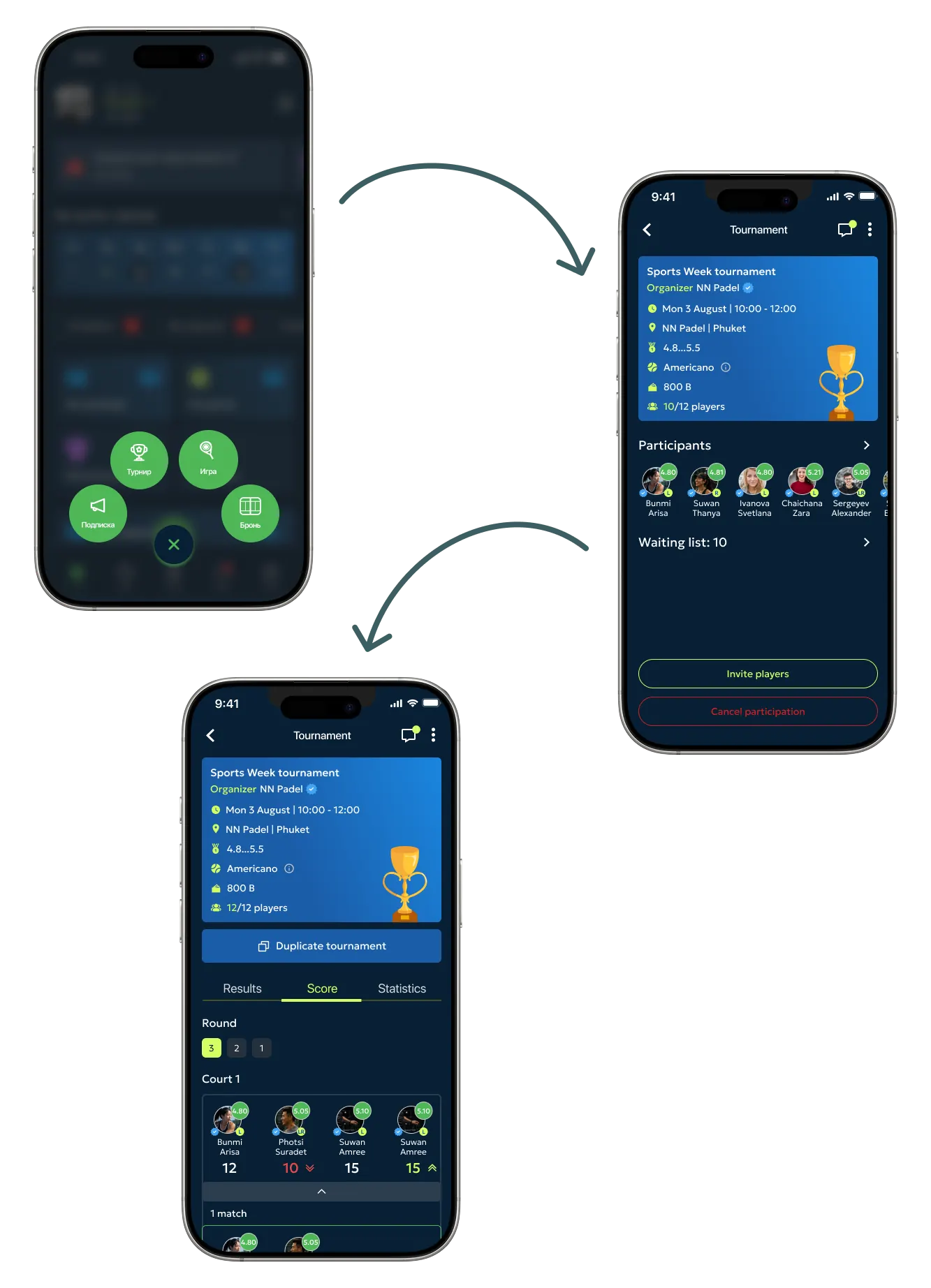
One tournament, start to finish.
The same workflow covers a Tuesday club Americano and a weekend competition. What changes is the configuration, not the process.
Configure
Create from scratch or duplicate a previous tournament. Set organizer, club, date, time, duration, format and visibility.
Publish or invite
Open it to the community, or keep it private and invite the players you want.
Manage participants
Approvals, waiting list, replacements, pairs and restrictions — applied by rule rather than by hand.
Generate rounds
Courts, start conditions and round generation according to the chosen format.
Run and score
Enter results as they happen, adjust score limits, correct mistakes safely.
Complete and share
Final standings published to participants and visible in the app.
Mark which steps are available now and which depend on format or market setup (spec 19 §3). Steps depending on payments are flagged in section 7.
Formats
One engine, many kinds of event.
A Tuesday club social, a rated open, a weekend knockout and a season-long league are different evenings — but the same six settings describe all of them. Pick a family, then tune it.
Americano
Partners change every round and points are scored individually. The social default: nobody is stuck with the same pair all evening, and the rating spread evens out on its own.
Best for club social nights and mixed ratings.
Mexicano
Each round is drawn from the current standings, so you always meet opponents on a similar score. Competitive without needing accurate seeding before the first ball.
Best for open events with an unknown rating spread.
King
Individual scoring with rotating partners, and courts ranked by performance. Winners move towards court one, which keeps the pressure on right to the last round.
Best for regular club nights with a strong core group.
Escalera
A ladder across courts: winners move up, losers move down. Thirty seconds to explain, and it runs the same way week after week.
Best for recurring weekly sessions across several courts.
Round Robin
Fixed pairs, everyone plays everyone. The format when the result has to be defensible and the table has to be complete. Can be run as one group or several, with a play-off stage on top.
Best for club championships, league stages and seeded groups.
Knockout — the Olympic system
A single-elimination bracket: lose once and you are out, win and you move on to the next round. The format everyone recognises, and the one that gives an event a real final.
Seeding places the strongest pairs apart, byes fill an uneven draw, and the bracket updates as each result is entered. A third-place match and a consolation round for early losers can be switched on so nobody drives home after twenty minutes.
Best for weekend opens, finals days and the play-off stage after group play.
[PLACEHOLDER — knockout, consolation and double-elimination options need product confirmation before this copy is published. Group stage → bracket combinations should be confirmed at the same time.]
Leagues and series
Several events joined into one standing: a monthly series, a club season, or a city ranking. Each event runs in its own format, and results roll up into a single table.
[PLACEHOLDER — series and league aggregation pending product confirmation.]
Flex, mixed and pair variants
Variants for fixed pairs, mixed-gender composition and flexible attendance, for the evenings that do not fit a standard family. Advanced settings appear once you choose the variant.
[PLACEHOLDER — exact variant list pending product confirmation.]
How the families differ
| Format | Pairing | Who you play next | Result | Runs best as |
|---|---|---|---|---|
| Americano | Rotating | Fixed rotation | Individual points | A social evening |
| Mexicano | Rotating | Nearest score | Individual points | An open with mixed ratings |
| King | Rotating | Court you earned | Individual points | A regular club night |
| Escalera | Rotating or fixed | One court up or down | Court position | A weekly ladder |
| Round Robin | Fixed pairs | Everyone in the group | Full table | A championship group |
| Knockout | Fixed pairs | Winner of the other tie | Bracket to a final | A finals day |
| League / series | Any | Depends on the event | Cumulative standings | A season |
Six settings shape every event
Entry
Solo players or ready-made teams; open registration, invitation only, or approval from a waiting list.
Pairing
Partners rotate every round, or pairs stay fixed for the whole event.
Who can join
Rating range, gender composition, verified players only, club members only.
Scoring
Points, games or sets, with a score limit you can change mid-event if the schedule slips.
Progression
Fixed rotation, standings-based draw, court ladder, full table or elimination bracket.
Scale
Number of courts, round length and total duration — from one court after work to a full-day event.
Participants
Rules do the moderating.
Set the entry conditions once and the tournament enforces them. Most of the manual work in padel events is admissions, replacements and the waiting list — all three are handled by the system.
Who can enter
Solo players or teams, rating range, gender composition, verified-player restriction.
How they enter
Direct entry, invitation, or approval from a waiting list you control.
When plans change
Replacement, removal, pair management and automatic waiting-list movement.
If the event shrinks
Reset and reconfigure safely when attendance does not match the plan.
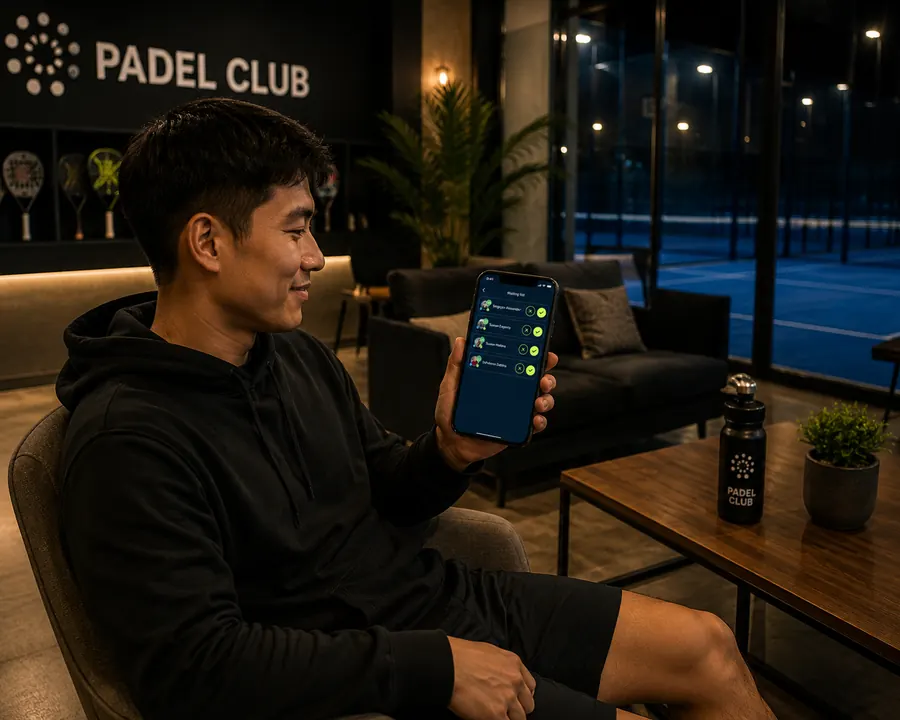
Confirmed players, pending approvals and waiting list in one view, with the entry rules visible at the top.
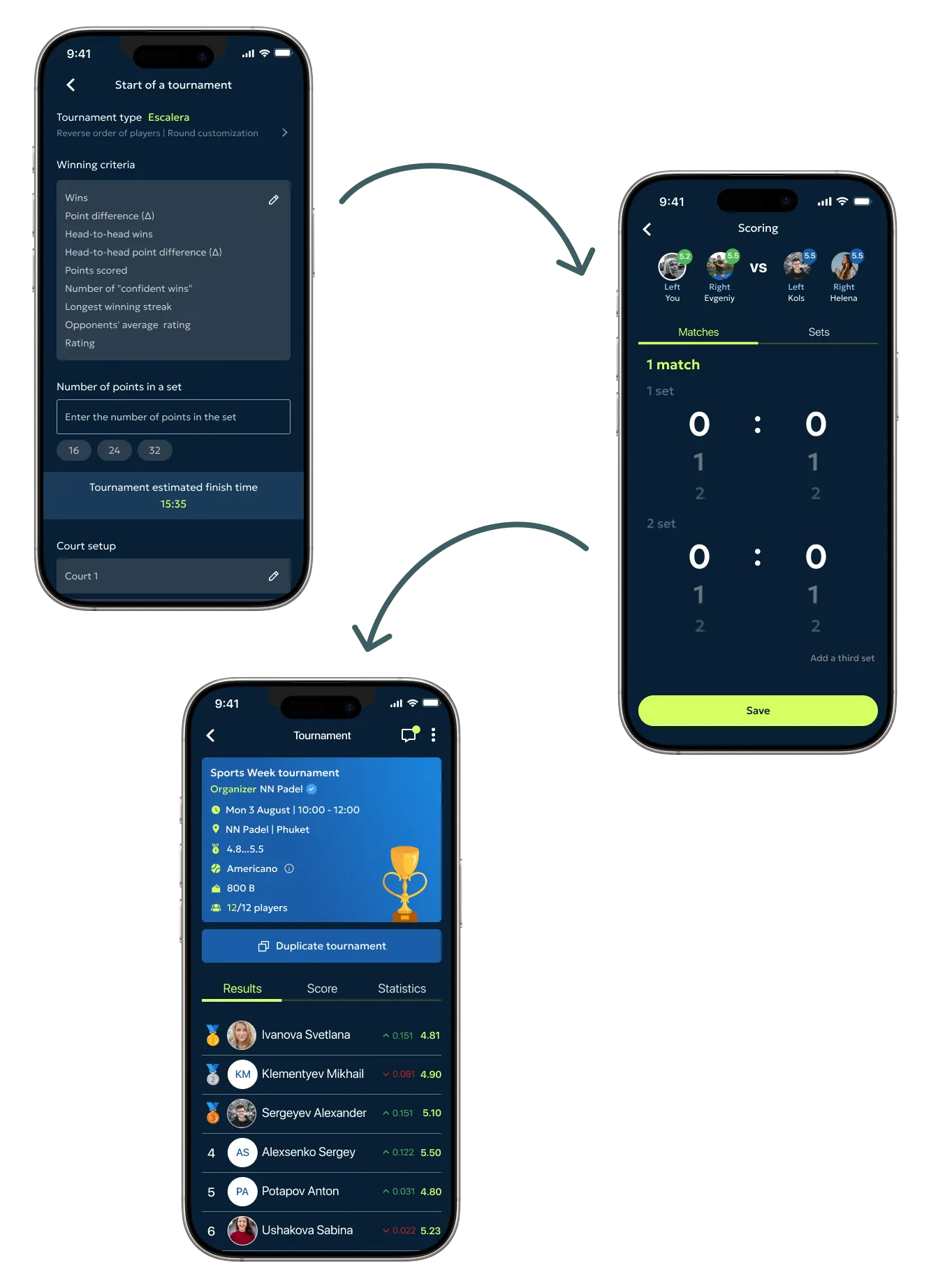
Court setup, score entry and final standings in one flow.
Live operations
Control while it is happening.
The evening rarely goes to plan. A player arrives late, one court is unusable, a round has to be shortened. Those changes are part of the workflow rather than a reason to start over.
- Name and number the courts the way your club actually labels them
- Define start criteria and winner calculation before the first round
- Enter scores and generate the next round from the result
- Adjust the score limit when the schedule slips
- Correct or reset a round without breaking the standings
- Coach mode for training-oriented sessions — more for coaches
Add an offline or poor-connectivity fallback claim only if the product supports it (spec 19 §6).
Payments & refunds
Entry fees are yours. Processing fees are theirs.
Lunda Padel does not take a commission on your entry fees. Where payment collection is available, it runs through an external provider, and that provider charges its own processing fee.
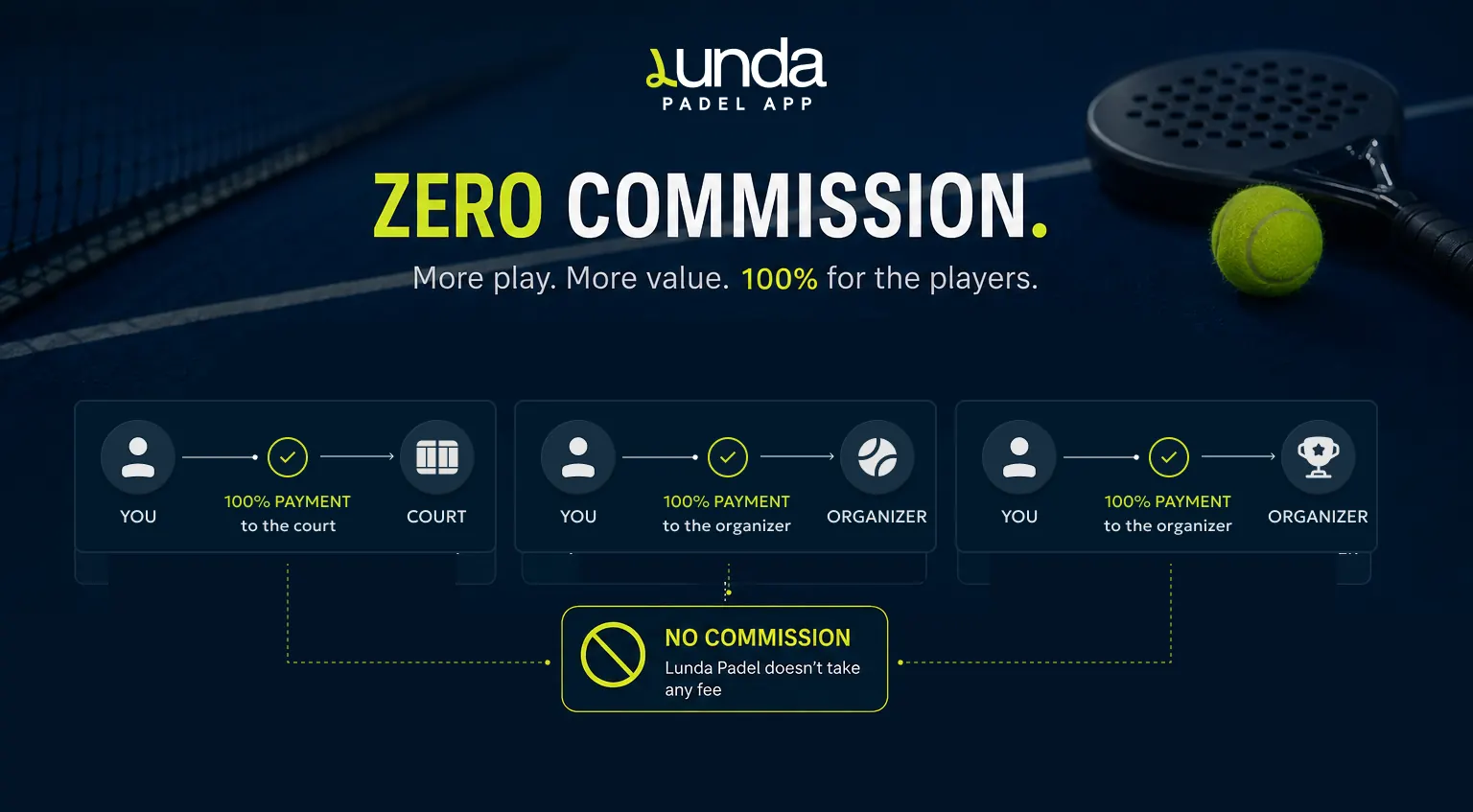
Three plain rows — organizer entry fee, club court fee, payment-provider processing fee — with Lunda Padel's row explicitly at zero. Same visual language as the homepage “Why free” diagram.
Community growth
A recurring event builds a scene.
Events published through Lunda Padel are visible to players in the app, and the players who turn up become the audience for the next one. Over time that regular activity is also what makes a club want to work with you.
Visibility
Your events appear where players are already looking for something to join.
Retention
Results, ratings and history give players a reason to come back to your series.
Club relationships
Filled court time is the argument clubs respond to. See the club platform
Getting started
Send the form. We take it from there.
Tell us what you organize and we set up your organizer access, walk you through formats and setup, and stay with you through the first event.
Send the form
Name, contact, where you organize, a couple of lines about your events.
We set up your access
Organizer rights on your Lunda Padel account, plus a walkthrough of setup, formats and live operation.
Create your first event
With support available while you run it.
No response-time or SLA promise until approved (spec 19 §9, §12).
Proof
Organizers already running events.

Quote, name, role, organization, market, permission status.
One series over several months: setup time, participants, retention.
FAQ
Organizer questions.
Who can become an organizer?
You need a Lunda Padel App account and an approved application. Send the form, and we set up your access and guide you through the first event.
Which formats are supported?
Americano, Round Robin, Mexicano, King, Escalera and flex, mixed and pair variants, each with its own settings.
What does it cost?
There is no Lunda Padel subscription and no Lunda Padel commission on entry fees. Where payments run through an external provider, that provider charges its own processing fee.
Is there a participant limit?
[PLACEHOLDER — limits per format and per event pending product confirmation.]
Do I need to work with a club?
You need courts, so most organizers work with one. If the club is on the Lunda Padel club platform, court availability and event publication are connected. If it is not, you can still run the event. Coaches running clinics work the same way — see the coaches page.
What support do I get?
A walkthrough when you receive access, and support while you run events.
What happens to participant data?
You see the participant information needed to run the event. Communication with players goes through the platform. Details are in the Privacy Policy and the organizer terms.
Application
Start your organizer application.
Fill this in and we will come back to you with organizer access and everything you need to run your first event.
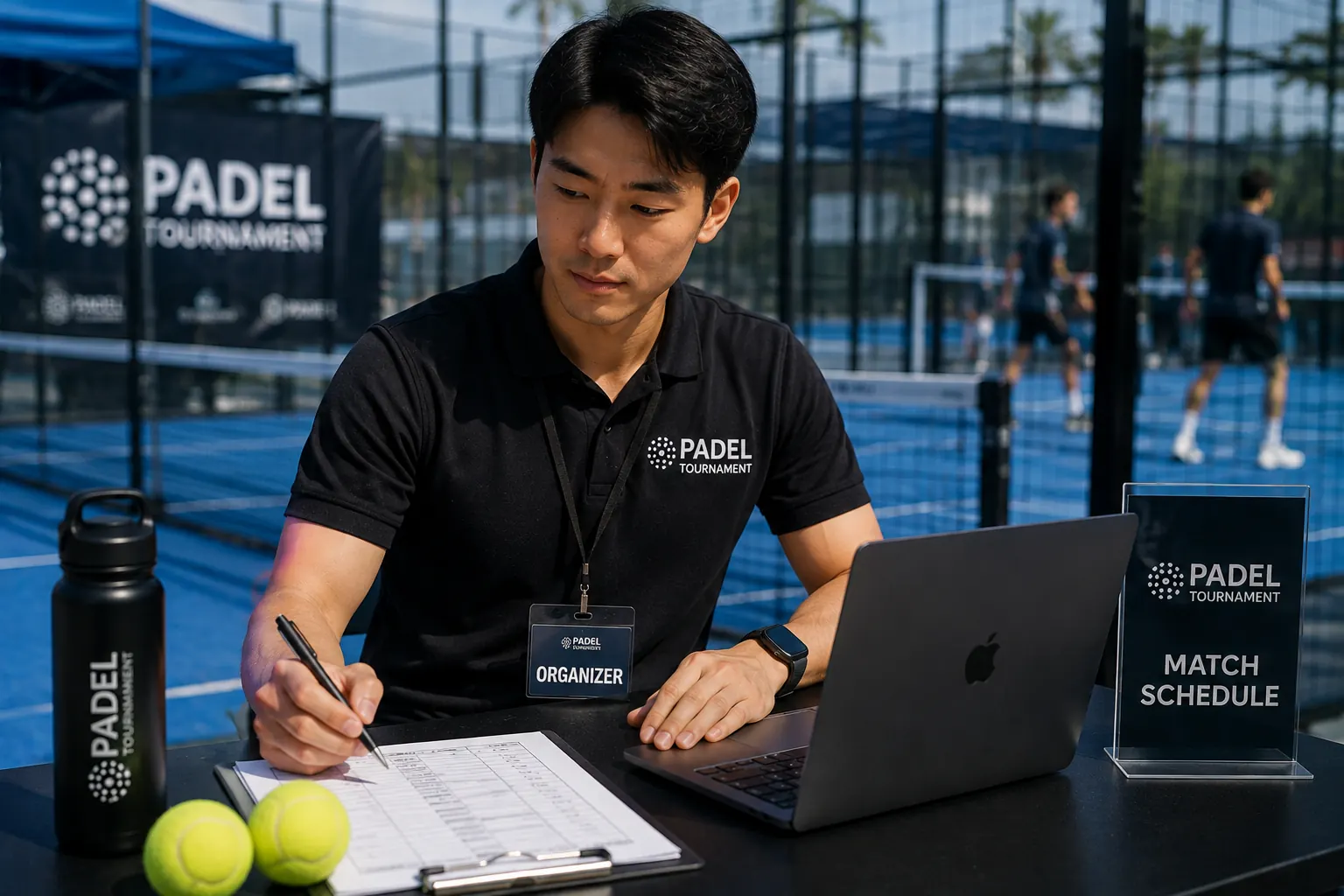
A real organizer at their own event. Named, with a release on file.
IDEA — photograph them at their own event, holding the phone they actually run it on. A working portrait, not a studio one.